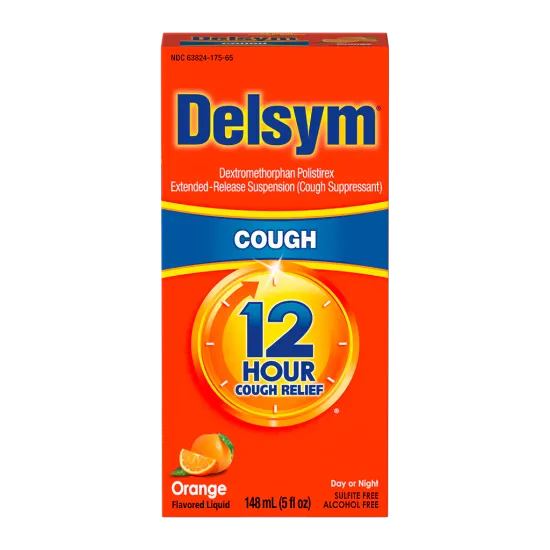
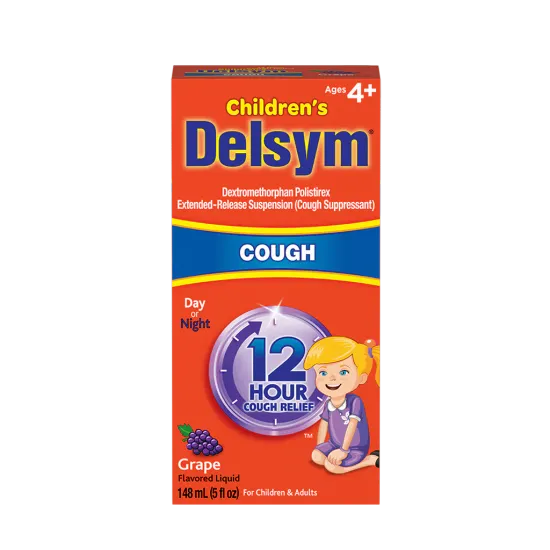
.avif)

DAY & NIGHT


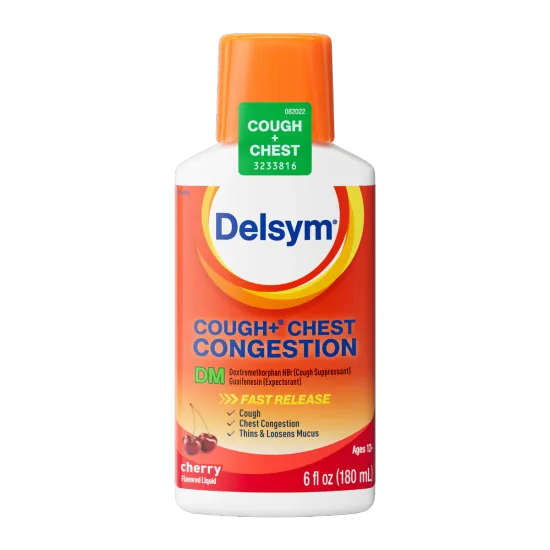

Benzonatate is a prescription capsule that numbs throat and lung receptors, while Dextromethorphan is an over-the-counter (OTC) suppressant that works on the brain’s cough center. Dextromethorphan, especially in extended-release polistirex form, like Delsym, offers a convenient non-prescription option for long-lasting 12-hour relief without the need for a doctor's visit.
When a stubborn cough won’t quit, the right cough suppressant can make all the difference, but not all options work the same way.
What’s the difference between a Prescription and an OTC medicine?
Over-the-counter (OTC) medications are drugs you can buy directly from a pharmacy or store without a prescription, making them convenient for treating everyday issues like coughs, colds, or minor pain.
Prescription medications, on the other hand, must be approved by a licensed physician, and are typically used when a medical condition requires closer supervision or stronger treatment.
While OTC drugs are considered safe when used as directed, taking too much or using them incorrectly can cause side effects, or even hide symptoms of a more serious problem.
Prescription drugs also go through a more extensive development and approval process, including clinical trials and strict regulatory review.
Understanding how cough suppressants differ can help you choose the right option. Or explore alternatives like diphenhydramine, polistirex, guaifenesin, or ambroxol if your symptoms require a different approach.
Here are some key considerations:1
If you’re on a journey to understanding our active ingredients benzonatate vs dextromethorphan, it likely means you’re searching for the most effective way to quiet a persistent, dry cough and get some relief.
Differentiator | Dextromethorphan | Benzonatate |
Availability | No wait time. Available over-the-counter | An appointment with a physician and a prescription is required |
Mechanism of action | Acts in the central nervous system to suppress the cough reflex (sigma-1 receptor agonist and NMDA receptor antagonist)2 | Acts peripherally at the lungs and airways, as an anesthetic on stretch receptors, to prevent the sensory nerves from transmitting impulses to the brain’s cough reflex center.4 |
Preferred use | Considered first in treatment for controlling cough owing to the fact that it is found in many OTC antitussives. Seen to be effective in reducing cough intensity. | When dextromethorphan does not work, a doctor should be consulted and they may prescribe benzonatate. Effective in cough associated with lung cancer. |
Safety/risks | Superior benefit to risk ratio. | High risk of severe reaction if chewed or dissolved, because of its anesthetic action on oral linings. Not to be used in patients at risk for aspiration.5 |
Among the OTC cough suppressants available, you have the option to choose a fast acting version dextromethorphan hydrobromide, whose effects begin to show within 15-30 minutes of taking the medication and lasts for 4-6 hours only.6 Or choose a long acting formulation: dextromethorphan polistirex, whose action begins around the same time but lasts approximately 2-3 times longer than standard dextromethorphan HBr.7
The Polistirex Advantage:7
If you’re comparing cough medicines like guaifenesin vs dextromethorphan; or dextromethorphan vs diphenhydramine, you should first identify the type of cough you have and then choose a suitable product.
Type of cough | Suitable OTC medication contains | How it works |
Dry cough | Dextromethorphan | Cough suppressant: Acts to suppress the cough reflex in the central nervous system2 |
Wet cough | Guaifenesin or Ambroxol | Expectorant: thins and loosens mucus in the airways, making it easier to cough up, commonly for colds or bronchitis8 |
Allergy cough | Diphenhydramine | Antihistamine: preventing histamine from binding to receptors, reducing allergic reactions. Used to treat allergy symptoms.9 |
The next step is to choose a product that suits your needs. Do you prefer a capsule, tablet, topical application or a liquid? For example, you can compare Delsym® products to find one that’s most suitable to your dosage requirement, formulation, combined with another ingredient or that contains your favorite flavor.
When OTC products are formulated with ingredients like dextromethorphan, guaifenesin, diphenhydramine, or ambroxol, they offer the benefits of liquid cough medicine for effective relief, including faster soothing of the throat, easier dosing, and a combination of cough suppression, mucus thinning, or antihistamine support depending on the formula.
Despite the fact that OTC medications are available for purchase without a prescription, care must to take to follow all the recommended guidelines for treating a lingering cough, so that safety is maintained and side effects are minimized (if not eliminated).
Some general guidelines are:
By using these medications carefully and seeking medical advice when needed, you can treat a lingering cough safely, while giving your body the support it needs to recover and feel better.
Pathak, A., Upadhyay, V., Gund, S., Kumar, P., Tiwary, T., Vats, K., Prakash, S., Singh, R., Singh, U., Nakade, R., & Benen, P. Real-world Insights on the Care and Management of Cough: A Physician Survey in India. International Journal of Research and Review. 2025 https://doi.org/10.52403/ijrr.20250510.
Taylor, C., Traynelis, S., Siffert, J., Pope, L., & Matsumoto, R. Pharmacology of dextromethorphan: Relevance to dextromethorphan/quinidine (Nuedexta®) clinical use.. Pharmacology & therapeutics. 2016; 164. https://doi.org/10.1016/j.pharmthera.2016.04.010.
Dextromethorphan. Reactions Weekly. 2019; 1759. https://doi.org/10.1007/s40278-019-70315-5.
Evans, S., Maglinger, B., Fletcher, A., & Johnson, S. Benzonatate inhibition of voltage-gated sodium currents. Neuropharmacology. 2016; 101. https://doi.org/10.1016/j.neuropharm.2015.09.020.
Kim, I., Goulding, M., Tian, F., Karami, S., Pham, T., Cheng, C., Biehl, A., & Muñoz, M. Benzonatate Exposure Trends and Adverse Events.. Pediatrics. 2022 https://doi.org/10.1542/peds.2022-057779.
Cammaerts, M., & Cammaerts, R. Side effects of the cough drug dextromethorphan, studied on ants as models . MOJ Biology and Medicine. 2021 https://doi.org/10.15406/mojbm.2021.06.00128.
Seltzer, J., Sheth, S., Friedland, S., Foreman, E., Toney, C., Raviendran, R., McDaniel, M., & Lasoff, D. Life-threatening pediatric dextromethorphan polistirex overdose.. The American journal of emergency medicine. 2022 https://doi.org/10.1016/j.ajem.2022.08.006.
Drugbank. 2026 Guaifenesin. Accessed in March 2026, at: https://go.drugbank.com/drugs/DB00874.
Drugbank. 2026 Diphenhydramine. Accessed in March 2026, at: https://go.drugbank.com/drugs/DB01075.
Food and Drug Administration. FDA Should You Give Kids Medicine for Coughs and Colds?. Accessed in March 2026, at: https://www.fda.gov/consumers/consumer-updates/should-you-give-kids-medicine-coughs-and-colds.
Note: These statements have not been evaluated by the Food and Drug Administration. This product is not intended to diagnose, treat, cure, or prevent any disease.